

Best Hooks & Rigs for Saltwater Fishing | Asalt Fishing
The definitive guide to saltwater fishing hooks and rigs for Northeast anglers. We break down every hook type — circle, octopus, and baitholder — then cover the best pre-tied rigs for every species: striped bass,...
Best Hooks for Saltwater Fishing
Every hook type explained — circle, octopus, baitholder, and complete rigged setups. Built for the water, by anglers who fish it.
The hook is the only thing standing between you and the fish. Everything else — your rod, reel, line, bait — is just getting that connection into the water. In saltwater, the stakes are higher: corrosive conditions, powerful fish, and increasingly strict regulations all demand that you choose the right hook for the right situation.
Whether you're chunking bunker for bluefish off a jetty, drifting soft plastic for fluke along a sandy bottom, or live-lining a peanut bunker for striped bass, this guide breaks down exactly which hook to reach for — and why. All products linked below are from our own lineup, built for Northeast saltwater fishing by anglers who live it.
Why Hook Choice Matters in Saltwater
Freshwater fishing is forgiving. Saltwater is not. Cheap hooks corrode after a single trip. Light-wire hooks straighten under the sustained pull of a large bluefish or a bull striper. Improperly matched hooks let fish use the bait without triggering a bite — or worse, deep-hook fish you're trying to release.
The three factors that matter most when selecting a saltwater hook:
- Material & coating — High carbon steel with a black nickel or corrosion-resistant coating is the minimum standard for saltwater.
- Point sharpness & style — Chemically sharpened points penetrate faster under light pressure, which matters when you're fishing live bait that needs to swim naturally.
- Hook type for the technique — A circle hook fished with cut bait behaves completely differently from an octopus hook on a drift rig. Match the tool to the job.
Always carry at least three hook styles when saltwater fishing: a circle hook for chunk or live bait, an octopus hook for rigs and teasers, and a baitholder hook for cut or strip bait on the bottom. Conditions change fast — so should your rig.
The Core Saltwater Hook Types
There are dozens of saltwater hook variants, but all of them descend from a handful of proven designs. Here's what you need to know about each one we carry.
Circle Baitholder
Inline, non-offset. Self-sets in the jaw corner. Baitholder barbs hold bait securely through aggressive bluefish strikes.
Tournament LegalOctopus Hook
Short shank, round bend, offset point. Versatile — works on rigs, teasers, and live bait. Sizes up to 10/0 for big game.
Most VersatileBaitholder Hook
Barbs on shank grip soft baits, worms, cut bait. Stays baited through multiple casts and strikes.
Cut & Strip Bait1. Circle Baitholder Hooks — Tournament Legal, Inline
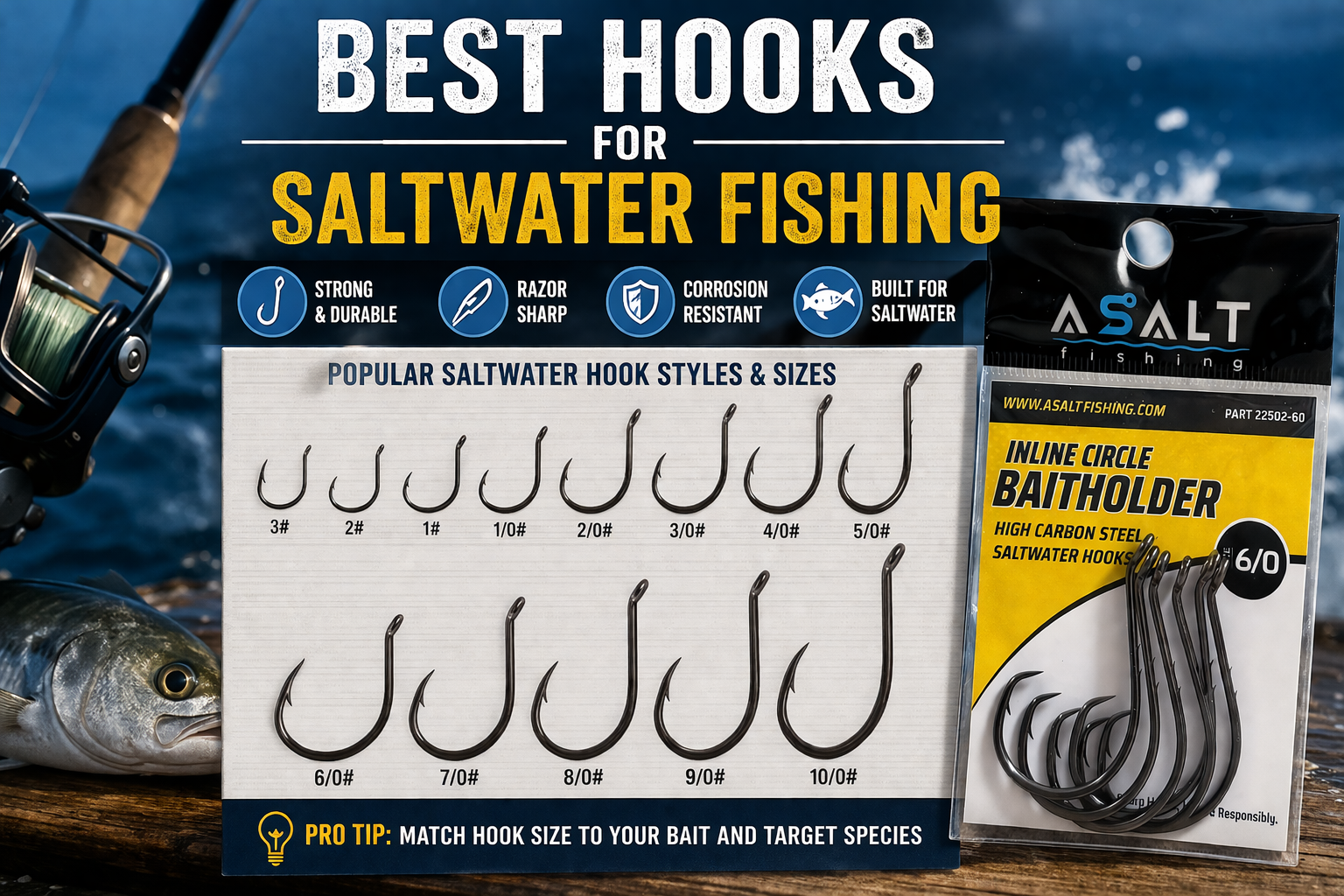
Our Inline Circle Baitholder Hooks are built to meet the strictest tournament and regulatory standards. Unlike offset circles, these are non-offset — meaning the point aligns directly with the shank. This design is required by law in a growing number of regulated saltwater fisheries, and it's also simply the most effective hook for catch-and-release fishing.
What makes them different: The baitholder barb on the shank is a game-changer for bluefish and striper fishing. Chunk baits — bunker, mackerel, or squid — are notorious for flying off the hook on a long cast or getting stripped clean on a short strike. The baitholder barb holds your bait in place through all of it.
How to fish them: Rig your bait and let the fish run. When you feel steady pressure, reel down and apply smooth, firm tension — don't snap strike. The hook's curved point rotates out of the bait and finds the corner of the fish's mouth automatically. It's one of the most reliable ways to convert bites to landed fish.
Non-offset (inline) circle hooks like ours are now required when using natural bait for many federally managed reef fish species and in specific Northeast state fisheries. Always verify with your state's fish & wildlife agency before heading out.
2. Octopus Hooks — The All-Around Saltwater Workhorse
The octopus hook is arguably the most versatile hook in saltwater fishing. Its short shank and round bend profile present bait naturally in the water with minimal weight, and its offset point digs in quickly on the strike. Our Octopus Hooks are available in an exceptionally wide size range — 1/0 all the way up to 10/0 — covering everything from sheepshead and sea bass on the smaller end to big bull stripers and doormat fluke on the larger sizes.
Best uses:
- Tying into fluke drift rigs and hi-lo bottom rigs (our hand-tied Fluke Drift Rigs use octopus hooks for exactly this reason)
- Live-lining bunker peanuts, spot, or small mackerel for striped bass
- Fished under a cork or float for black sea bass, porgy, and fluke in deeper holes
- Pairing with soft plastic tails on jig heads for inshore species
3. Baitholder Hooks — Grip It and Fish It
When you're fishing with worms, strips of squid, cut bunker, or sand eels, a standard J-hook will have your bait sliding down the shank after the first cast. The baitholder barbs on our Baitholder Hooks prevent exactly that — locking soft and slippery baits in place so they present correctly throughout the drift or soak.
Ideal scenarios: Hi-lo bottom rigs targeting sea bass, porgies, and flounder in shallow bays and near structure. Surf fishing with clam or worm for kingfish, weakfish, and pompano. Pier and bridge fishing where aggressive baitfish will steal your bait in seconds if it isn't secured.
Available in sizes 2 through 7/0, covering the full range from small panfish bait hooks up to large chunk-bait rigs for big bass.
Complete Rigged Setups
If you want to skip the rigging and get straight to fishing, our pre-tied and USA-assembled rigs come ready to clip on. Every rig uses the hooks above, matched to the exact species and technique they're designed for.
Bluefish Rigs — Built for Teeth
Bluefish are the most destructive fish in the Northeast surf. Their razor-sharp teeth will slice through monofilament leader in a single pass, which is why wire is non-negotiable on any bluefish rig. Both our bluefish rig options include an 80 lb black coated stainless steel wire leader measuring 18" — enough to withstand the most aggressive strikes without cramping bait action.
Circle Hook Rig (our signature): Our Bluefish Rig with Circle Baitholder Hooks is USA assembled and uses the same 8/0 inline circle baitholder hook as our standalone hook packs, meaning you're getting tournament-grade hook performance with zero rigging time. Perfect for chunking large baits off the surf or from a boat.
Standard Rig (budget option): When you're fishing a high-volume blitz and burning through rigs fast, our Standard Bluefish Rig gives you a reliable, affordable backup. Long shank hooks and shorter wire leaders keep the cost-per-rig low without sacrificing bite protection.
Always use long-nose pliers or a dehooker when handling hooked bluefish — their teeth can do serious damage. Our aluminum alloy hook extractor is purpose-built for safe, one-handed removal without touching the fish. Keep it clipped to your bag on every trip.
Fluke Rigs — Drift Ready, USA Tied
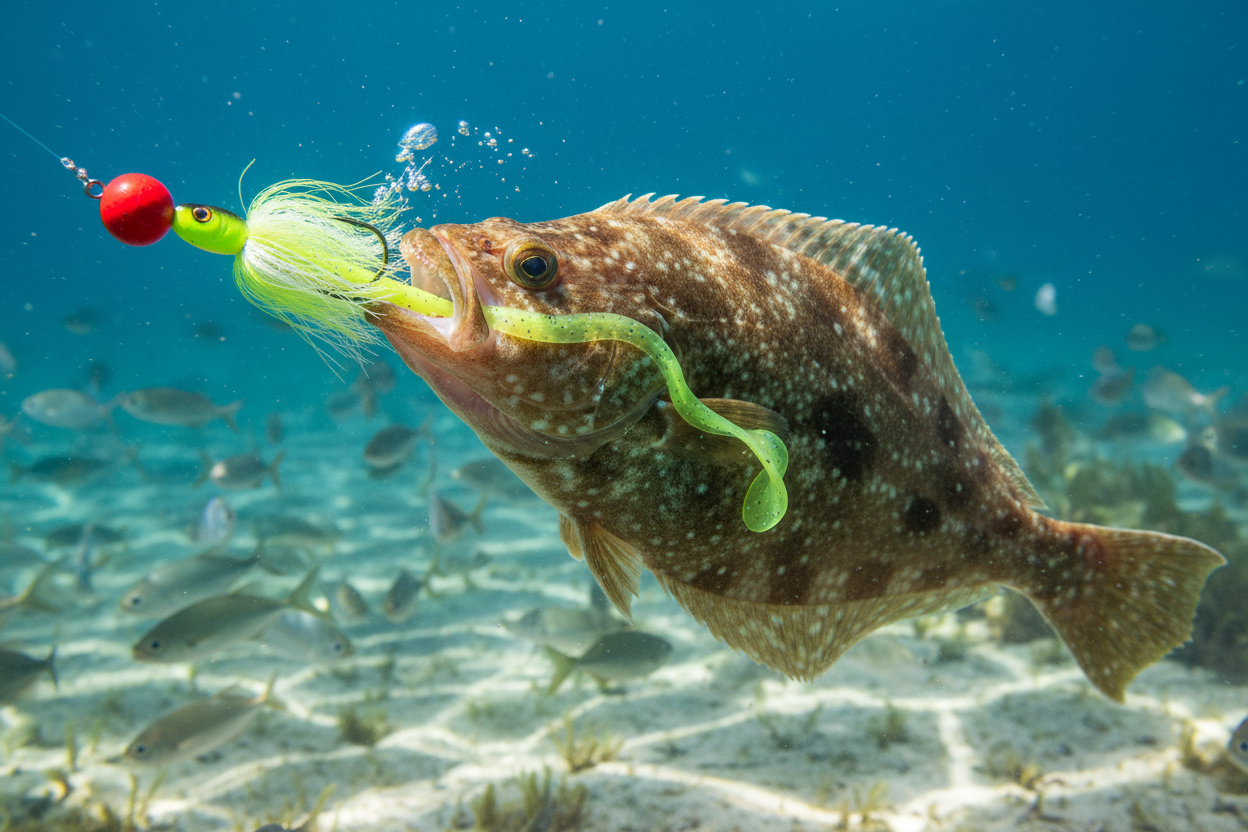
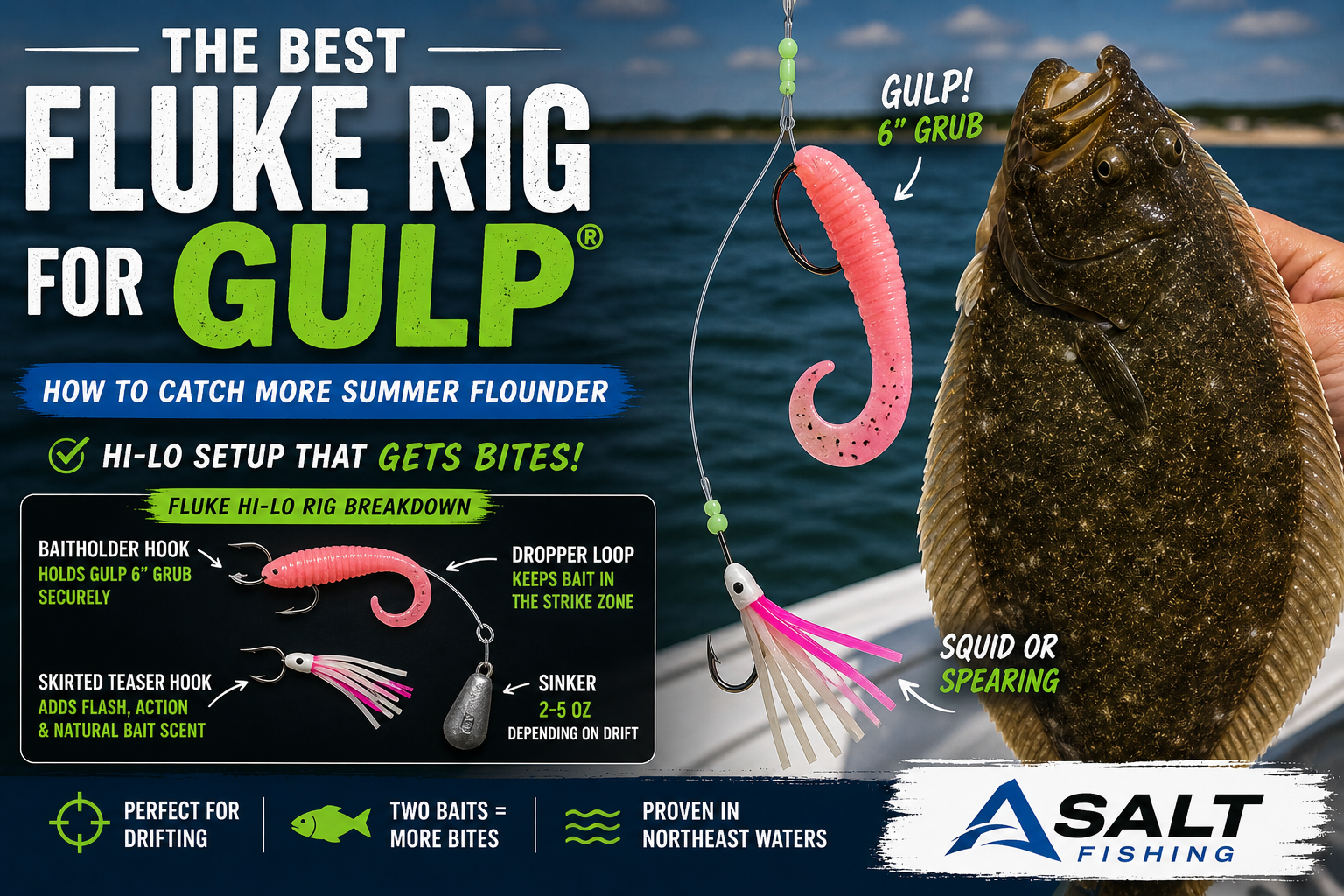
Fluke (summer flounder) are a drifter's fish — they respond to moving bait above the sandy bottom, which is why a properly tied drift rig with a bucktail teaser is the most consistent producer year in and year out. Both our fluke rigs are hand tied in the USA using octopus hooks, the proven standard for fluke presentation.
Fluke Drift Rig (single hook): Our Fluke Drift Rig features a single octopus hook dressed with a bucktail teaser and comes complete with swivel and 3-way sinker snap. Available in Pink, White, and Chartreuse — match to water clarity and light conditions. Chartreuse in stained water, white or pink in clear conditions.
Fluke Hi-Lo Double Bucktail Rig: The Hi-Lo Double Bucktail Rig gives you two octopus hooks — both dressed with bucktail teasers — presented at different depths simultaneously. This rig covers more of the water column, doubles your bait presentation, and lets you trial different bait styles on each hook at the same time.
"If a fluke rig is rigged right, the hook barely matters — but if it's rigged wrong, even the sharpest hook won't save you."
— Asalt Fishing Pro StaffStriped Bass Rigs — USA Tied, Circle Hook Ready
Striped bass are the premier Northeast inshore gamefish — powerful, intelligent, and increasingly regulated. Many states now require non-offset circle hooks when using natural bait for stripers, which is exactly why every Asalt Fishing striped bass rig is built around our legal non-offset circle baitholder hook. You're not just fishing better — you're fishing legal.
We offer three distinct striper rigs, each designed for a specific situation on the water. Understanding when to use each one is the difference between a slow day and a box full of fish.
Rig 1 — Hi-Lo Double Hook Rig
The Striped Bass Hi-Lo Rig is built for bottom fishing with two baits at once — one hook positioned higher in the water column, one near the bottom. This is the go-to setup when bass are holding tight to structure and you want maximum bait coverage. The hi-lo configuration also lets you experiment with different baits on each hook simultaneously — clam on one, sandworm on the other — to find what's working fastest.
Both hooks are non-offset circle baitholders in sizes 4/0–8/0, hand tied in the USA on a rig complete with swivels and a bottom sinker loop.
Rig 2 — Fishfinder Rig
The Striped Bass Fishfinder Rig is the top choice for surf fishing and boat fishing where the bait needs to move freely along the bottom. The braid-ready fishfinder sinker slider allows the main line to run through the weight independently — meaning a bass can pick up and move with the bait without ever feeling resistance. By the time you come tight, the hook is already in the fish's mouth.
This rig includes a braid-ready fishfinder (sinker slider), brass swivel, and 3-way sinker snap, all hand tied in the USA with a single non-offset circle baitholder hook.
Rig 3 — Drift Rig
When stripers are feeding in current — bridges, inlets, river mouths, or nearshore rips — the Striped Bass Drift Rig is the right tool. Designed to be fished on the swing or dead-drifted through moving water, this rig presents live or cut bait naturally with minimal hardware. The brass swivel and 3-way sinker snap give you a clean connection with no line twist, even in heavy current.
Bottom fishing over structure or in the surf? Use the Fishfinder Rig — the sliding sinker lets bass pick up bait without feeling the weight.
Working a rip, bridge, or inlet current? Use the Drift Rig — it's built for natural presentation in moving water.
Want two shots at a bite from the bottom? Use the Hi-Lo — double hooks, double the chances.
Porgy (Scup) Rigs — More Hooks, More Fish
Porgy fishing is a numbers game. When the bite is on, you want as many baited hooks in the water as possible — which is exactly why our porgy rigs are built around multi-hook hi-lo designs. Porgies are aggressive biters that hit quickly and hard, but their small mouths require appropriately sized hooks (sizes 1 through 6) with secure bait retention.
We offer two distinct porgy rig styles depending on how many hooks you want working at once and whether you prefer mono or wire construction:
Standard Porgy Hi-Lo Rig
Our Porgy Hi-Lo Rig features two hooks on mono dropper loops with red beads, a swivel, and 3-way bottom sinker snap. The dropper loops present bait naturally off the bottom where porgies feed. Available in sizes 1, 2, 4, and 6 — go smaller (4 or 6) in clear water, larger (1 or 2) when you're targeting bigger fish.
3-Drop Wire Porgy Rig — Triple the Action
When the bite is hot and you want maximum coverage, the Porgy Hi-Lo 3-Drop Wire Rig puts three hooks in the water simultaneously. Built on a 3-arm wire leader with beads, swivel, and bottom sinker snap — wire construction adds rigidity so dropper arms stand out horizontally, presenting all three baits clearly separated and away from the main leader. Available in sizes 1, 2, and 4.
Clam and sandworm are the top baits for porgy, but keep pieces small — about thumbnail-sized. Porgies have small mouths and will steal large baits without getting hooked. On a 3-drop wire rig, try alternating clam and worm on neighboring hooks to find what they're keying on that day.
Black Sea Bass Rigs — Structure Fishing Done Right
Black sea bass are structure fish — they live in wrecks, rocky reefs, and hard bottom, and they fight hard on the way up. A good sea bass rig needs to be strong enough to handle abrasion against barnacle-covered steel, while still presenting bait naturally just above the bottom where sea bass feed.
Our Sea Bass Hi-Lo Rig is hand tied in the USA with a pair of baitholder hooks, red attractor beads, a swivel, and a bottom sinker loop. The baitholder barbs keep squid strips and clam bites locked on even through the churn of a fast drift over structure. Available in sizes 1/0, 2/0, and 3/0 — use 2/0 as your go-to, stepping up to 3/0 when targeting jumbo humpbacks.
Fresh-salted clam strips and squid are the gold standard for sea bass over structure. Cut squid into thin strips and thread them lengthwise onto the baitholder hook so they trail naturally. The red beads on our Sea Bass Hi-Lo Rig provide additional visual attraction in deeper, darker water over wrecks — a difference you'll notice in the bite count.
Blackfish (Tautog) Rigs — The Slider Advantage
Tautog (blackfish) are among the most technical fish to target on the Northeast coast. They live tight to structure, have powerful crushing jaws designed to crack crab shells, and will steal your bait without you feeling a thing if your presentation is off. The key is a natural, unweighted presentation right in the structure — and double-hooking your bait so there's no way they get it clean.
Our Blackfish Slider Rig is our best seller for East Coast tog fishing and is hand tied in the USA. It features one snelled hook paired with a free-sliding second hook — the sliding hook allows you to thread both hooks through a green crab or whelk bait, covering the entire bait and dramatically reducing clean steals. Complete with a swivel, it clips directly onto your main line.
Tautog have hard, powerful mouths — always check your hook point after each fish. Their bony jaws will roll a point fast. Also note that blackfish seasons are tightly regulated in most Northeast states — verify your season dates, bag limits, and minimum size before fishing. Hook size matters too: match hook size to bait (green crab = larger hook, fiddler crab = smaller).
Blowfish Rigs — Simple, Fast, and Delicious
Blowfish (northern puffer) are one of the most underrated table fish on the Northeast coast — light, sweet, and incredibly easy to clean once you know how. They're also stupidly fun to catch, hitting aggressively on the bottom in bays, inlets, and near bridges from late spring through summer.
Our Blowfish Hi-Lo Rig is built for exactly this style of fishing: pre-tied, ready to clip on, and designed for fast, efficient bay and pier fishing. Sharp, durable small hooks, strong terminal tackle, and a hi-lo layout that keeps both baits right in the strike zone. Great for blowfish, porgies, sea bass, and other small bottom species from boats, piers, and bay bridges.
Blowfish respond best to small pieces of bloodworm, sandworm, or clam strip fished right on the bottom. They congregate in large numbers — when you find them, you'll know it fast. A hi-lo rig lets you keep two baits fishing simultaneously so you can work through a school quickly without re-rigging between bites.
Snapper Popper Rigs — Surface Action for Snapper Blues
Late summer brings one of the most exciting inshore fisheries on the Northeast coast: snapper bluefish (juvenile bluefish) schooling near the surface in bays, harbors, and around docks. They're aggressive, fast, and incredibly fun — especially for kids and new anglers. Snapper popper rigs are tailor-made for this: a weighted, brightly colored float creates surface commotion that draws schools to the surface, while a small sharp hook below the float closes the deal.
We offer four snapper rig options — three weighted popper variants and one traditional float bait rig — so you can match the presentation to what the snappers are keying on that day:
Snapper Popper — With Worm
The Snapper Popper With Worm is rigged with a soft rubber worm trailer that adds lifelike movement below the surface on every twitch of the rod. One of the most consistent producers when snappers are selective about bait type.
Snapper Popper — With Lure
The Snapper Popper With Lure pairs the weighted popper float with a small artificial lure trailer — great when snappers are boiling on baitfish and you want to match the profile without dealing with live or cut bait.
Snapper Popper — With Spoon
The Snapper Popper With Spoon adds a small spinning spoon below the float for maximum flash and vibration — particularly effective on overcast days or in slightly stained water where snappers are hunting by sight and lateral line.
Snapper Bait Rig — Classic Float Setup
Prefer live bait? The Snapper Bait Rig With Float is your setup — a bright, easy-to-see float holds the bait at adjustable depth while giving you a clear visual strike indicator. Perfect for teaching beginners and kids how to fish, and just as effective when snappers are feeding subsurface on silversides and shrimp.
Work the popper with short, sharp twitches — "pop, pop, pause." The pause is when most strikes happen. Snappers school tight, so once you find them, stay on the spot and keep casting. Silversides, small pieces of spearing, and tiny shrimp all work well tipped on the hook below the popper or float.
Materials & Corrosion Resistance
All Asalt Fishing hooks are made from high carbon steel with black nickel coating — the optimal combination for saltwater fishing. Here's how different materials stack up:
| Material / Coating | Corrosion Resistance | Best For | Notes |
|---|---|---|---|
| High Carbon Steel + Black Nickel ✓ | Good–Very Good | All-around saltwater (our hooks) | Chemically sharpened; low visibility to fish |
| Stainless Steel | Excellent | Offshore, wire rigs | Used in our bluefish wire leaders; not always legal for bait fishing |
| Bronze / Tin | Low–Moderate | Budget option, freshwater | Rusts fast in full salt; replace often |
| Chrome Plated | Moderate | Visibility rigs | Attracts light; useful in murky water |
Bottom line: Black nickel coated high carbon steel is the standard for good reason — sharp from the pack, low glare in the water, and durable enough for a full season if rinsed after every outing. Our chemically sharpened points require no filing out of the package.
Hook Size Chart by Target Species
Use this as your quick field reference. Hook sizing is counterintuitive below size 1 (a size 4 is smaller than a size 1) — but above 1, the aughts take over in ascending order: 1/0, 2/0, 3/0, and up.
| Target Species | Circle Hook Size | Octopus / Baitholder Size | Best Bait |
|---|---|---|---|
| Bluefish (inshore) | 5/0 – 8/0 | 4/0 – 6/0 | Chunk bunker, mackerel, squid |
| Striped Bass | 5/0 – 7/0 (Hi-Lo, Fishfinder, or Drift Rig) | 4/0 – 6/0 | Live bunker, eels, clam, sandworm |
| Fluke / Flounder | — | 2/0 – 4/0 (octopus) | Squid strips, spearing, soft plastics |
| Black Sea Bass | 4/0 – 5/0 | 1/0 – 3/0 (baitholder) | Squid, clam, fresh-cut bait |
| Porgy / Scup | — | Sizes 1, 2, 4, 6 (Hi-Lo or 3-Drop Wire Rig) | Clam strip, sandworm, squid |
| Black Sea Bass | — | 1/0 – 3/0 (Sea Bass Hi-Lo Rig) | Squid strip, salted clam, crab |
| Blackfish / Tautog | — | Slider Rig (Blackfish-specific) | Green crab, fiddler crab, whelk |
| Blowfish / Puffer | — | Small (Blowfish Hi-Lo Rig) | Bloodworm, clam strip, sandworm |
| Snapper Blues | — | Small (Snapper Popper or Bait Rig) | Silversides, shrimp, spearing, soft lure |
Pro Tips for Rigging & Hook Care
- Test sharpness before every session. Drag the point lightly across your thumbnail — if it catches, it's sharp. If it skates cleanly off, it's dull. Our chemically sharpened points come sharp from the pack, but check after every big fish.
- Match hook size to bait, not just fish. A 6/0 circle hook on a small squid strip will restrict the bait and kill action. Use the smallest hook that cleanly holds the bait without overpowering it.
- Don't snap-strike on circle hooks. Reel down, apply steady pressure, and let the hook do the work. Snapping the rod like a J-hook set will pull the circle hook out of the fish's mouth every time.
- Rinse every hook after use. Even black nickel coated high carbon steel will show rust if left in a wet tackle box. A quick fresh-water rinse and dry before storage extends hook life significantly.
- Inspect rigs before re-fishing. After a bluefish, check every inch of your rig — they damage wire, bend hooks, and fray connections. Replace any component that looks stressed before your next drop.
- Use a dehooker on every trip. Fast, humane hook removal protects the fish and your hands — especially important when bluefish are involved.
Essential Hook Accessories
The right hook is only half the equation. These two accessories will change how you fish and how well your fish survive release.
Frequently Asked Questions
Are your circle hooks tournament legal?
Yes. Our Circle Baitholder Hooks are non-offset (inline), which means they comply with the stricter regulations used in most East Coast and Gulf Coast saltwater tournaments, and with federal regulations requiring non-offset circle hooks for many reef fish species when fishing with natural bait.
What size hook should I use for bluefish?
For most inshore bluefish fishing with chunk bait, use a 6/0 or 8/0 circle baitholder hook or a 4/0–6/0 octopus hook. Our Bluefish Rigs come pre-rigged with 8/0 circle hooks and an 80 lb wire leader — the complete setup, ready to fish right out of the pack.
What's the difference between octopus and baitholder hooks?
Octopus hooks have a short shank, round bend, and offset point — excellent for rigs, teasers, and live bait that needs to swim naturally. Baitholder hooks have barbs on the shank that physically grip the bait and prevent it from sliding off — best for soft, slippery baits like squid strips, sandworms, and cut clam.
How do I fish the Fluke Drift Rig properly?
Position your boat to drift with the current over sandy bottom, drop-offs, and edges. Let the rig sink to the bottom, then slowly lift and drop the rod tip as you drift to bounce the rig naturally. When fluke bite, they often "tap" first — give them a second to fully commit, then set with a firm upward sweep. Tip the octopus hook with a squid strip or spearing for best results.
How often should I replace saltwater hooks?
Replace any hook that shows rust, a rolled or blunted point, or deformation in the bend. After a big fish or multiple trips, test the point against your thumbnail — if it doesn't immediately catch, it needs replacing. Rinse all hooks in fresh water after every session and store them dry to maximize life between replacements.
What's the best rig for striped bass fishing?
It depends on the technique. For surf fishing and open-bottom boat fishing, the Fishfinder Rig is best — the sliding sinker lets bass pick up and move with the bait before feeling resistance. For bridge, inlet, and current fishing, the Drift Rig presents bait more naturally in moving water. When bottom fishing over structure with multiple baits, the Hi-Lo Double Hook Rig gives you two shots at a bite simultaneously. All three of our Striped Bass Rigs use legal non-offset circle baitholder hooks and are hand tied in the USA.