

How to Catch Black Sea Bass in the Northeast | Asalt Fishing
Learn how to catch black sea bass in the Northeast with tips straight from 50 years on the water. Joe Castelli covers the best locations from New Jersey to Cape Cod, seasonal timing, top rigs,...
How to Catch Black Sea Bass in the Northeast: The Complete Guide
Black sea bass (Centropristis striata) are one of the most exciting and delicious fish you can target along the Northeast coast. From New Jersey to Cape Cod, these aggressive structure-dwellers put up a remarkable fight on light tackle — and taste incredible at the dinner table.
If you’re not consistently catching Black Sea Bass in the Northeast, you’re either fishing the wrong structure, using the wrong rig, or missing the bite entirely.
Whether you're fishing from a headboat out of Point Pleasant, dropping jigs around Montauk's rocky ledges, or working wrecks off Rhode Island, this guide will walk you through everything you need to know to find, hook, and land black sea bass consistently throughout the season.
Black sea bass are a member of the grouper family and are protogynous hermaphrodites — meaning they can change sex from female to male as they grow older. Dominant males develop a striking blue hump on their head during spawning season. Legal size in the Northeast (federal waters) is typically 15 inches, though check your state regulations for specifics.
Understanding Black Sea Bass Behavior
Before you can consistently catch black sea bass, you need to understand how they live. These fish are obligate structure fish — they spend nearly their entire lives within feet of hard bottom, wrecks, reefs, or rocky outcroppings. You will almost never find them suspended in open water.
Black sea bass are highly territorial and aggressive feeders. They establish pecking orders on structure, with the largest dominant males controlling the best feeding zones. This means the first drop on any new piece of structure almost always produces the biggest fish.
Seasonal Migration & Prime Timing
Black sea bass follow a predictable seasonal pattern along the Northeast coast:
🌸 Spring (May–June)
Fish move inshore from their winter grounds in deeper offshore waters. Target nearshore wrecks and reefs in 40–80 feet. Action picks up fast as water temps hit 58°F+.
☀️ Summer (July–Aug)
Peak inshore season. Fish spread across all structure. Shallow reefs (20–60 ft) come alive. Ideal for light tackle anglers and party boats alike.
🍂 Fall (Sept–Oct)
Trophy season. Fish stack up on structure before migrating offshore. Larger fish are more common. Work wrecks in 60–120 feet for the best shots at bulls.
❄️ Winter (Nov–Apr)
Fish push offshore to 150–300+ feet off the continental shelf edge. Specialized deep-drop techniques are required. Party boats sometimes run extended offshore trips.
Top Locations in the Northeast
Black sea bass thrive at hundreds of spots along the Atlantic seaboard, but these areas are consistently productive:
Wrecks of New Jersey & New York
The waters off Manasquan, Barnegat Inlet, and Montauk are littered with sunken vessels that hold enormous populations of black sea bass. Wrecks like the Tolten, the Arundo, and the numerous artificial reef sites are legendary. The NOAA reef site finder is an invaluable tool for locating these spots.
Rhode Island & Block Island Sound
The rocky bottom, ledges, and reefs of Block Island Sound produce trophy black sea bass all season long. The Southwest Ledge off Block Island is a standout location, as are the numerous boulder fields north of Watch Hill. Charter boats out of Galilee have exceptional success here.
Stellwagen Bank & Cape Cod, MA
Massachusetts offers world-class black sea bass fishing from mid-summer through October. Stellwagen Bank, the South Channel, and Nantucket Shoals hold massive concentrations of fish in the fall. Cape Cod Bay fishing picks up significantly from August onward.
Delaware Bay & Maryland Offshore
The artificial reefs and natural ledge structures south of Delaware provide excellent early-season action. Some of the largest fish in the region come from these waters, which see less pressure than the more northern spots.
The Right Gear Setup
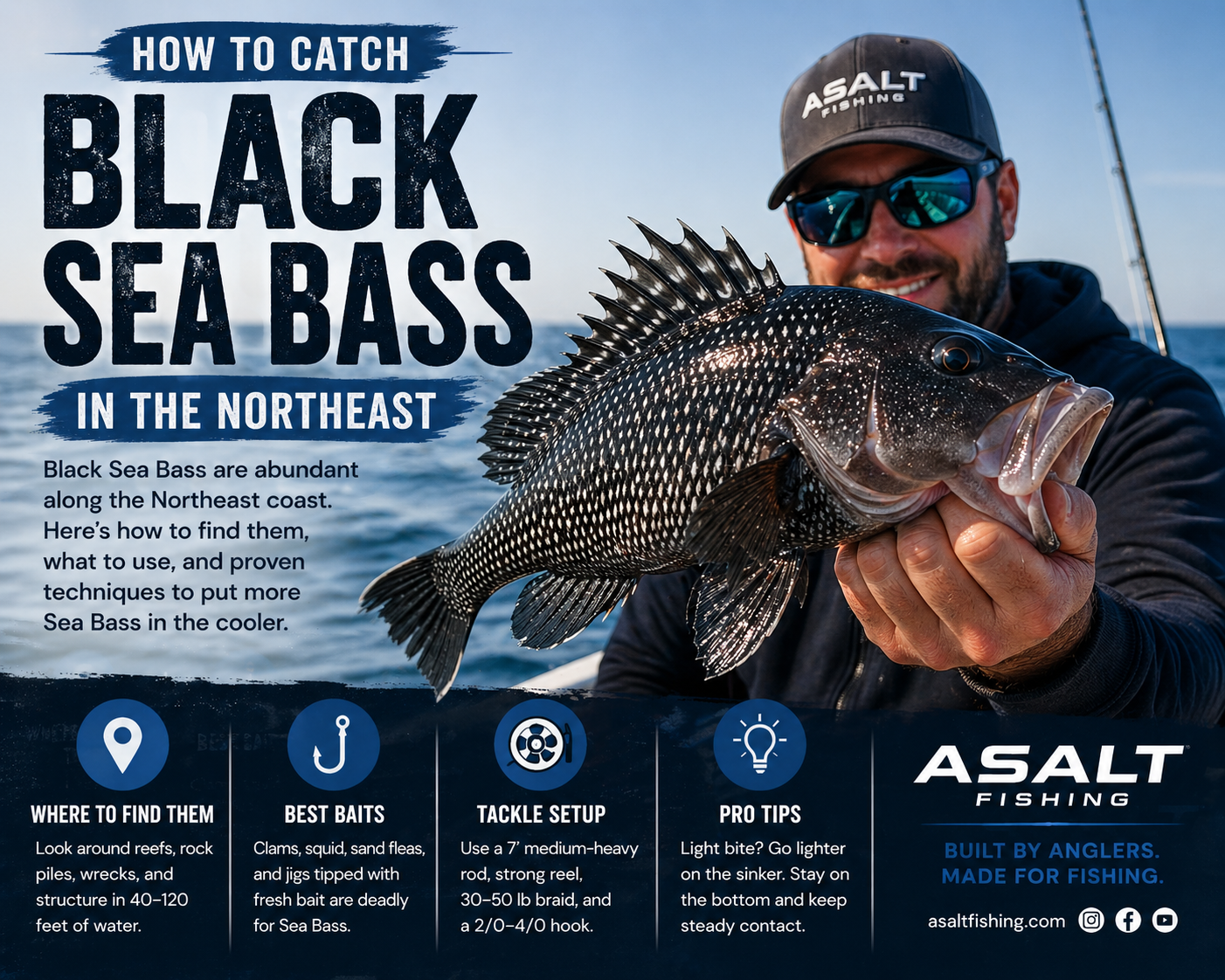
| Category | Inshore (30–80 ft) | Offshore (80–200+ ft) |
|---|---|---|
| Rod | 6'6"–7' medium-heavy, fast action | 5'6"–6' heavy action, sensitive tip |
| Reel | Conventional or spinning 3000–5000 | Level-wind conventional, high retrieve |
| Main Line | 20–30 lb braid (thin diameter) | 40–65 lb braid |
| Leader | 20–30 lb fluorocarbon, 2–3 ft | 40–50 lb fluorocarbon, 2–4 ft |
| Hook | Size 1/0–3/0 circle or octopus | Size 3/0–5/0 circle hooks |
| Sinker | 2–6 oz bank or egg sinker | 8–24 oz depending on current |
Pro Tip: Always use braided line with a fluorocarbon leader. Braid's lack of stretch gives you unmatched sensitivity for feeling the bottom and detecting subtle bites in deeper water, and its small diameter helps cut through heavy currents.
Best Rigs for Black Sea Bass
Two-Hook Dropper Loop Rig
The classic setup for black sea bass. Tie two dropper loops 6–8 inches apart above your bank sinker. Attach Fluke Killer or Seaworm Flasher hooks. This rig lets you present two baits at different levels above the bottom. It's the go-to on party boats for good reason — it's deadly effective.
Single-Hook Knocker Rig
Thread your egg sinker onto your main line and tie directly to a circle hook. The sinker "knocks" against the hook eye, creating vibration that attracts fish. This rig is excellent when fish are picking off bottom and you want direct contact with your bait.
Bucktail & Teaser
A 1–3 oz white or chartreuse bucktail with a soft plastic trailer (Berkley Gulp, Bass Kandy Delight) fished on a 3-way swivel above a heavy sinker is a fantastic light-tackle option in shallower water. Jig it 2–3 feet off the bottom with sharp, erratic hops.
Best Baits & Lures
Live & Fresh Baits
- Squid — The #1 most productive bait. Fresh squid strips or whole small squid on a two-hook rig are hard to beat.
- Sea Clam Strips — Incredibly tough bait that stays on the hook. Excellent scent trail. A staple on party boats.
- Bloodworms & Sandworms — Outstanding in shallower inshore areas, especially in spring when fish are actively feeding after the winter migration.
- Crab (Fiddler, Spider, or Calico) — Trophy fish are suckers for a half crab drifted along the bottom. Expect your biggest bites on crab.
- Shrimp (Grass or Pink) — Particularly deadly in Rhode Island and Massachusetts waters. Use fresh or live when available.
Artificial Lures
- Berkley Gulp Grubs or Swimming Mullet — A game-changer. These scented soft plastics outfish real bait on many days.
- Bucktails (1/2–2 oz) — White, chartreuse, or pink bucktails with a paddle tail trailer. Work the bottom aggressively.
- Vertical Jigs — Epoxy Jigs, Diamond jigs and butterfly-style jigs worked vertically produce explosive reaction strikes, especially from larger fish.
Techniques That Catch More Fish
Read Your Electronics — Find the Structure
Black sea bass don't roam — they live on specific pieces of bottom. Use your fish finder to locate hard structure, irregular bottom, or relief. A jagged, irregular bottom return on your screen almost always holds fish. Mark waypoints on any productive spots and come back to them.
Stay on the Bottom (But Not In It)
Your bait or lure needs to be within 1–3 feet of the bottom at all times. Too high and you'll miss fish; dragging bottom means constant snags. The sweet spot is just kissing the bottom — feel a tap, reel up a half turn. Constantly adjust as currents shift your presentation.
Chum to Stack Fish Under the Boat
A slow chum stream of crushed sea clam or menhaden oil draws sea bass up from structure and concentrates them under the boat. On anchor, a chum pot lowered to the bottom is extremely effective. Once you see bites slowing, refresh the chum and action typically resumes within minutes.
Work the Tidal Windows
Slack tide is often slow for sea bass as the bite requires some current. The two hours before and after a tide change — particularly the last of the outgoing and first of the incoming — are typically the most productive windows of the day. Time your trips to coincide with these transitions.
First Drop — Make It Count
As territorial fish, sea bass establish hierarchies. The very first drop on any new piece of structure will almost always produce the largest fish. Use your freshest bait, drop quickly to the bottom, and be ready. Big fish are on full alert and hit aggressively before they've been educated by repeated presentations.
Black sea bass regulations change annually. Always verify current size limits, bag limits, and open season dates with your state's Division of Marine Fisheries before your trip. Federal waters (beyond 3 miles) are governed by NOAA/NMFS, while state waters have their own rules. Penalties for violations are steep.
Handling & Conservation
Black sea bass brought up from depth may experience barotrauma — a condition where their swim bladder expands due to the pressure change, making it impossible to swim back down. If you're catching and releasing fish from deeper than 50 feet, a venting tool or descender device is essential for their survival.

Use a descender device to return fish to depth while they re-equilibrate, giving them the best chance of survival. Many tackle shops near Northeast fishing hubs carry these inexpensive tools, and their use is encouraged by fisheries managers.
Learn how to use a fish venting tool
Ready to catch more sea bass? Gear up with Asalt rigs built for the bite.