

Water Temperature and Fish Behavior: The Science Explained
Water temperature is the single most important variable in saltwater fishing — and most anglers overlook it. In this post, we break down the science of how temperature controls fish metabolism, feeding windows, and seasonal...
Water Temperature and Fish Behavior: The Science Explained
For saltwater anglers, understanding what's beneath the surface starts with understanding the temperature of the water itself.
Why Water Temperature Is the Master Variable
Ask any experienced saltwater angler what single factor most influences where fish are and how they're feeding, and most will give you the same answer: water temperature. Not tide. Not moon phase. Not bait availability — though all of those matter. Temperature.
Fish are ectotherms, meaning they cannot regulate their own body heat the way mammals do. Their internal temperature mirrors the water around them. This single biological reality shapes almost every behavior they exhibit: where they swim, when they feed, how aggressively they strike, how deep they go, and when they migrate hundreds of miles up or down the coast.
Understanding the science behind this gives anglers a genuine edge — not just a vague sense that "fish like warm water," but a precise, predictive framework for finding fish year-round.
Water temperature controls everything in saltwater fishing.
Where fish are.
When they feed.
How aggressive they are.
If you’re not paying attention to temperature, you’re fishing blind.
The Metabolic Connection
At the heart of the temperature-behavior relationship is metabolism. Like all chemical reactions, the biological processes that power a fish's body speed up as temperature rises and slow down as it falls — up to a point.
Each species has what scientists call a thermal preference zone — a temperature range where their metabolism operates most efficiently. Within this zone, fish digest food faster, recover from exertion more quickly, and have more energy available for hunting. Outside of it, their systems become stressed.
Practical takeaway: When water is in a fish's preferred thermal range, they feed more frequently and more aggressively. When it's too cold or too hot, feeding slows, fish become lethargic, and they often move to find better conditions.
Species-by-Species Temperature Preferences
Not all saltwater species are chasing the same conditions. Here's a breakdown of preferred temperature ranges for common inshore and nearshore targets:
| Species | Preferred Range | Becomes Inactive Below | Stress Above |
|---|---|---|---|
| Striped Bass | 55–65°F | 40°F | 75°F |
| Redfish (Red Drum) | 65–75°F | 50°F | 85°F |
| Flounder | 58–68°F | 45°F | 80°F |
| Bluefish | 60–75°F | 45°F | 82°F |
| Weakfish (Sea Trout) | 65–75°F | 50°F | 84°F |
| Tarpon | 74–88°F | 60°F | 95°F |
| Snook | 70–85°F | 60°F | 92°F |
| Mahi-Mahi | 72–85°F | 65°F | 90°F |
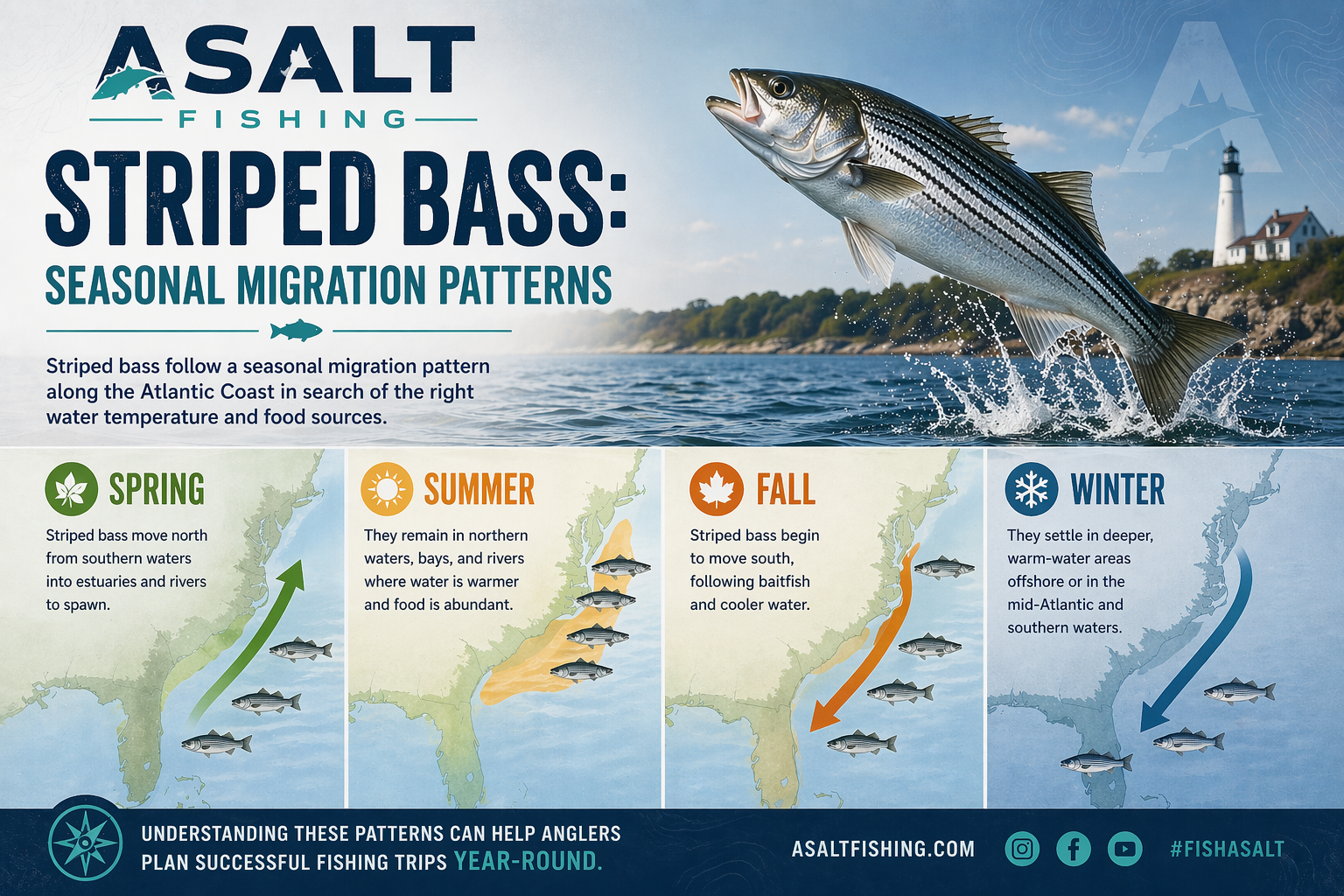
These ranges explain why the Northeast sees epic striper fishing in late spring and fall — when water temperatures bracket the 55–65°F sweet spot — while the Gulf Coast lights up for redfish in summer shallows that would shut down a Northern fishery entirely.
🎯 Fish Smarter with the Right Setup
Understanding water temperature is one thing.
Using the right rig is what actually catches fish.
When fish are:
- holding bottom → you need the right bottom rig
- feeding aggressively → you need strong bait presentation
👉 Shop rigs built for real conditions:
https://asaltfishing.com/collections/rigs
Thermal Layers and the Thermocline
In summer, stratification becomes one of the most important forces shaping where fish are found vertically in the water column.
As the sun heats the surface, a distinct boundary forms between warm upper water and cold deeper water. This boundary is called the thermocline. It's not a gradual fade — it can be a temperature drop of 10°F or more within just a few feet of depth.
Fish don't just casually cross the thermocline. Many species actively seek it out:
- Baitfish congregate near the thermocline, where cooler, nutrient-rich water meets warmer surface layers — creating a biological hotspot.
- Predators cruise the thermocline edges hunting those baitfish.
- Offshore species like tuna and mahi use the thermocline as a hunting highway, making it a prime target zone for trolling.
When fishing offshore in summer, knowing the thermocline depth — typically found with a fish finder or by reading sea surface temperature (SST) charts — tells you exactly where to set your lines in the water column.
Temperature Breaks: The Most Underused Tool in Saltwater Fishing
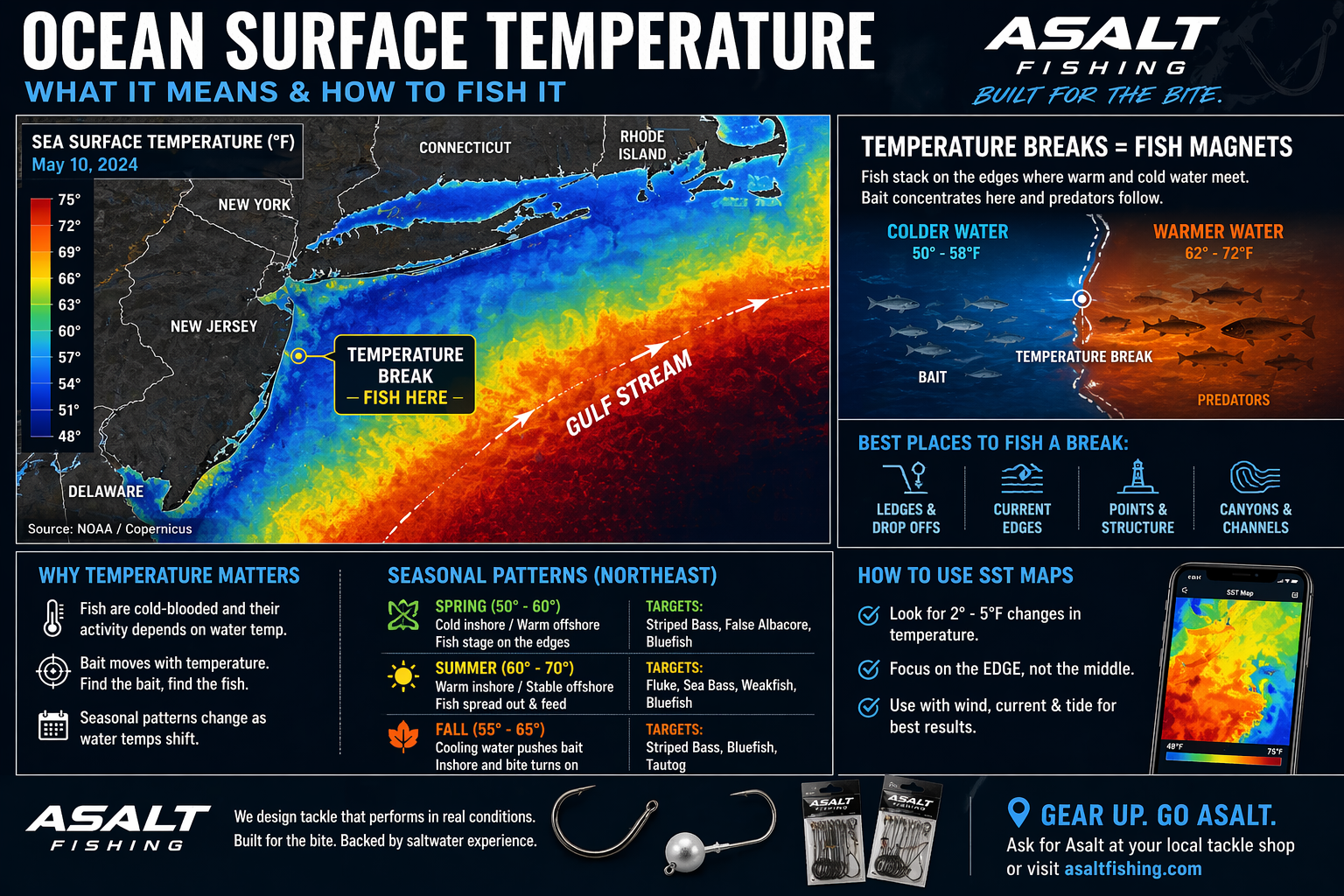
While most anglers understand that fish prefer certain temperatures, fewer exploit temperature breaks — edges where two water masses of different temperatures meet at the surface.
These breaks are visible on satellite-derived SST charts (available free from NOAA and apps like Hilton's Realtime Navigator) and often appear as distinct color shifts in thermal imagery. Along these edges:
- Currents collide, forcing baitfish to the surface
- Nutrient upwelling creates feeding frenzies
- Pelagic species like tuna, wahoo, and mahi stack in large numbers
Professional offshore captains spend considerable time studying SST charts before a trip. Following a temperature break — called "running the break" — is one of the most effective strategies in offshore fishing.
Seasonal Temperature Cycles and Migration
Temperature doesn't just affect where fish are right now — it governs the entire annual rhythm of saltwater fishing.
Spring Warm-Up
As water temperatures climb from winter lows, fish that overwintered in deeper, warmer water begin moving into shallower feeding grounds. For Northeast anglers, striped bass follow the 50°F isotherm northward from the Chesapeake, making their arrival predictable to within a few weeks based on water temps.
Summer Stratification
Surface temperatures peak. Inshore species spread out into shallower water; some retreat to deeper, cooler zones mid-day and move to the shallows to feed during cooler morning and evening windows. Offshore, the thermocline sharpens and becomes the primary structure.
Fall Feeding Frenzy
As temperatures drop from summer highs back into preferred ranges, fish enter a feeding frenzy — instinctively bulking up before winter. This is often cited as the best inshore fishing of the year for species like bluefish and stripers on the Northeast coast.
Winter Retreat
Water drops below feeding thresholds for most inshore species. Fish consolidate in deeper water where temperatures are more stable, and feeding slows dramatically. Some species (redfish, flounder) remain catchable year-round in Southern states; others (snook, tarpon) become nearly dormant.
Cold Shock: When Temperature Drops Kill
One phenomenon worth understanding — especially for anglers in Florida and the Gulf — is cold shock mortality, sometimes called a "cold stun event."
When nearshore water temperatures drop rapidly below about 50°F (in a matter of hours or days, as happens during cold fronts), fish that cannot escape fast enough suffer cold shock. Their nervous systems shut down. They float to the surface, often alive but completely incapacitated.
This happens most dramatically with snook and tarpon in Florida, where cold fronts occasionally push water temperatures down by 15–20°F overnight. FWC monitors and documents these events, and anglers sometimes encounter stunned fish — which are illegal to harvest but legal to rescue and release into warmer water.
How to Use Water Temperature Science on the Water
Here's how to apply these principles practically on every trip:
- Check water temperature before you go. Use a handheld thermometer, your depth finder's temp sensor, or NOAA SST charts. Know your target species' preferred range and fish accordingly.
- Fish the edges. The margins between warm and cold water — whether horizontal (surface breaks) or vertical (thermocline) — concentrate both bait and predators.
- Adjust your retrieve. In cold water, slow down dramatically. Fish are lethargic and won't chase a fast-moving lure. In warm water, speed it up — aggressive fish will strike.
- Fish structure in temperature extremes. When surface temps are too hot or too cold, fish retreat to structure (rocks, drop-offs, jetties) where temperatures are more stable.
- Follow the seasons, not the calendar. The bite doesn't turn on because it's May — it turns on because the water hits 58°F. Watch the thermometer, not the date.
Best Tools to Monitor Water Temperature
- NOAA CoastWatch — Free satellite-derived SST charts, updated daily
- Hilton's Realtime Navigator — Premium SST charts popular with offshore captains
- Windy.com — Includes SST overlays alongside wind and swell data
- Your depth finder — Most modern units display real-time surface temperature
- Local fishing reports — Many shops post weekly temp readings at key spots
The Bottom Line
Water temperature isn't just one factor among many — it's the organizing principle around which all other saltwater fishing variables rotate. Species location, feeding windows, migration timing, bait concentration, and strike aggressiveness all trace back, in one way or another, to the temperature of the water.
The anglers who consistently out-fish the crowd aren't necessarily the ones with the best gear or the most time on the water. They're the ones who understand why fish are where they are — and temperature is usually the first and most honest answer.
Start reading the water before you ever cast a line. The fish already are.
Up next: Moon Phases and Tidal Movement — How Lunar Cycles Affect Saltwater Feeding Windows
About the Author
Joe Castelli
Founder of Asalt Fishing and Northeast saltwater angler. Joe designs and tests rigs for striped bass, blackfish, and bottom fishing in real Northeast conditions.
Learn more about Joe →